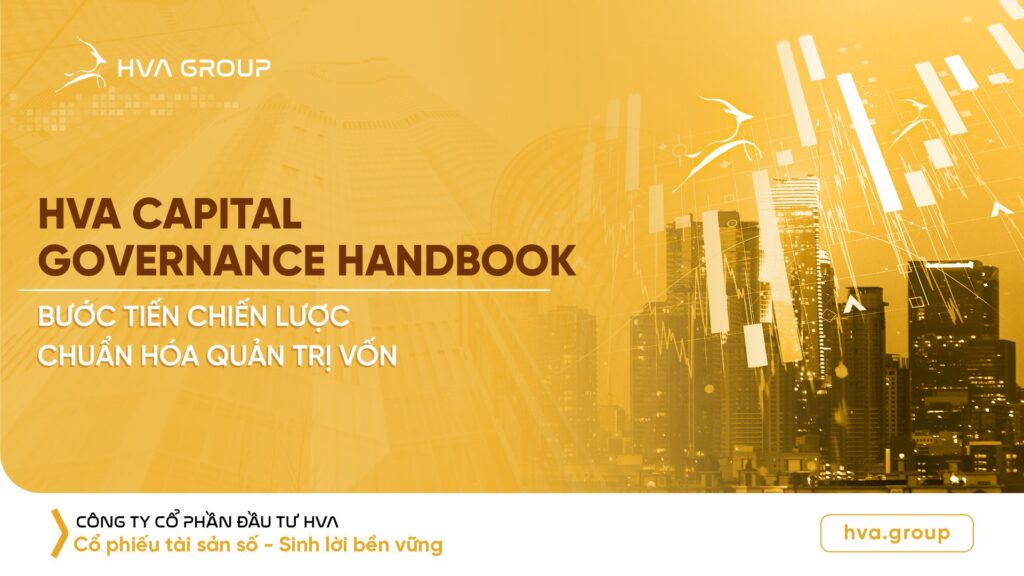
In the context of Vietnam's capital market becoming increasingly transparent and standardized, corporate governance capabilities – especially capital management and accountability – are being demanded at a higher level than ever before. To meet this requirement, HVA Group is implementing the HVA Capital Governance Handbook, a comprehensive handbook on capital and treasury stock management that will serve as the foundation for the Group's entire governance system in its next phase of development.
HVA Group consistently believes that the long-term value of a business does not come from reactive decisions in response to market fluctuations, but from the quality of capital allocation, risk management capabilities, and how the business measures performance over time. Therefore, building a unified, systematic capital governance framework that complies with Vietnamese law and international good governance practices is an essential step for HVA to operate as a professional, transparent, and responsible investment organization.
The core structure of the HVA Capital Governance Handbook
The HVA Capital Governance Handbook is designed as a high-level governance document, applicable throughout the Board of Directors, Executive Board, and member units within the HVA Group ecosystem. The handbook comprises several key components, each contributing to strengthening the foundation of corporate capital management.
Capital management philosophy
The introductory section of the handbook emphasizes the perspective of capital preservation and maintaining financial discipline as core principles. Instead of focusing on short-term market price fluctuations, HVA places emphasis on increasing intrinsic value over the cycle, ensuring that capital is used efficiently, prudently, and in a way that generates sustainable value.
Corporate architecture based on the holding model
With its holding company model, HVA Group plays a strategic role in allocating capital and overseeing the investment portfolio. The manual clarifies how HVA structures its business to isolate risk, optimize resources, and ensure that each investment is managed according to standards of transparency and accountability.
Capital allocation policy
HVA establishes a systematic capital allocation framework, including project evaluation criteria, principles for maintaining liquidity buffers, and a rigorous approval process. This policy helps businesses prioritize capital utilization, control investment speed, and limit impulsive decisions that could lead to unnecessary financial risks.
Treasury stock management
Instead of viewing treasury stock as a tool to influence market price, HVA defines it as an investment decision based on intrinsic value. Share buybacks are only undertaken when the market price is lower than the intrinsic value within a reasonable margin of safety, and when the purchase does not adversely affect liquidity or the value per share.
Capital Allocation Subcommittee
The Capital Allocation Subcommittee Mechanism Establishment Manual aims to ensure that all decisions related to significant cash flows are thoroughly vetted, fully documented, and overseen by independent management levels. This enhances transparency and accountability throughout the entire capital utilization process.
Standard Operating Procedure (SOP) for Treasury Stock
The SOP clearly describes the steps for buying, selling, and canceling treasury shares, from the approval process and transaction methods to information disclosure. This process helps HVA ensure compliance with the law and consistent operation across the entire system.
Investor Relations (IR) Principles
The handbook outlines principles for communicating with investors, emphasizing accuracy, timeliness, and a long-term perspective. HVA chooses a transparent approach, focusing on intrinsic value and strategy rather than offering short-term, emotionally driven expectations.
Risk control and periodic review mechanisms
A risk control system helps protect businesses and decision-makers, ensuring that all actions are taken within an agreed-upon framework. Furthermore, regular reviews help identify areas for improvement in a timely manner and allow for flexible adaptation to market changes.
Capital Management Index System: Measurement and Guidance Tools of HVA Group
To ensure that capital management goes beyond mere principles, HVA Group has developed a set of indicators to measure operational efficiency and guide strategic direction. These indicators include:
Financial safety group
HVA maintains a cash and liquid asset ratio of 15–25% of total assets, ensuring sufficient liquidity buffer for at least 12 months of operation. The net debt-to-equity ratio is controlled not to exceed 30%, while the current ratio is consistently maintained at 1.3 times or higher. These indicators help HVA maintain a solid financial foundation and mitigate risks from market fluctuations.
Capital allocation efficiency group
The return on investment at the portfolio level is measured cyclically with a target of 12–151 TP3T per year. HVA prioritizes allocating a minimum of 601 TP3T of capital to core investment segments and controls the rate of new investments to not exceed 201 TP3T of total assets per year, ensuring controlled growth.
Value per share group
Book value and cash flow per share are monitored with a 3–5 year outlook to maintain sustainable growth. Share dilution is controlled at a maximum of 5% per year, and HVA prefers no dilution unless absolutely necessary.
Treasury stock group
The budget for share buybacks shall not exceed 30% of the company's free cash flow for the year. The company shall only make buybacks when the market price is lower than the intrinsic value within a suitable margin of safety and shall not buy back if such activity negatively impacts liquidity or the value per share.
Governance and Compliance Team
The Capital Allocation Subcommittee meets at least four times a year, and all major capital allocation decisions must be approved by the General Meeting of Shareholders and the Board of Directors, with proper record keeping, minutes, and thorough verification. HVA aims to prevent information disclosure violations and strengthen confidence with shareholders and the market.
HVA Group's commitment to sustainable development
The launch of the HVA Capital Governance Handbook demonstrates HVA Group's strong commitment to improving corporate governance standards, enhancing transparency, and building long-term trust with shareholders. HVA does not operate based on short-term fluctuations but focuses on establishing a disciplined, measurable, and highly accountable capital governance system.
HVA believes that the governance foundations built today will lay the groundwork for stable, sustainable growth and increased real value for shareholders in the long term, while contributing to the healthy development of Vietnam's capital market.