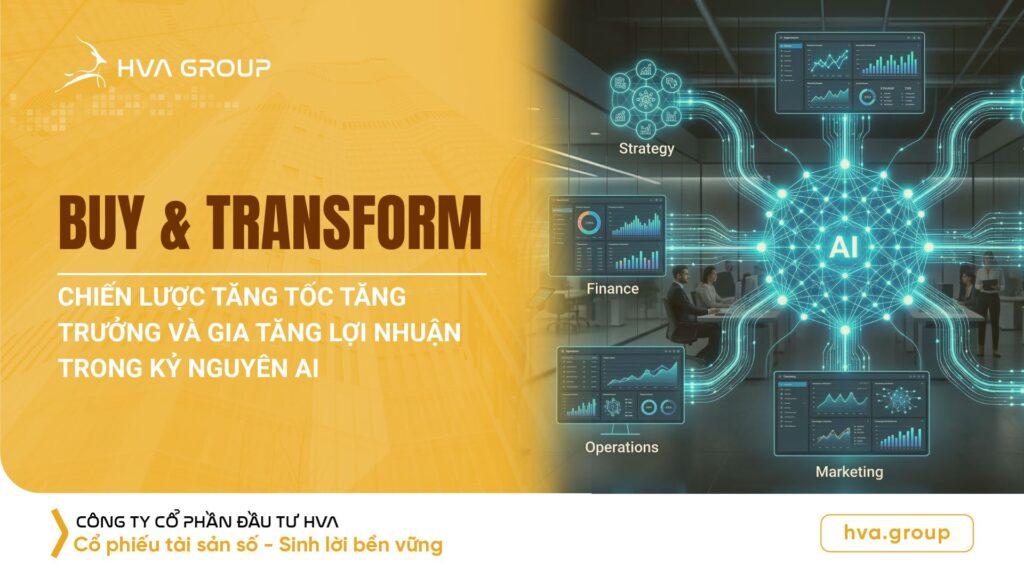
In the context of artificial intelligence reshaping business operations, the strategic question is no longer simply "should we adopt AI?", but rather "how to deploy AI to create a sustainable competitive advantage." For many investment organizations, the common choice often lies between two approaches: building a completely new model from scratch, or acquiring a traditional business and restructuring it using technology.
While in the early stages of technology startups, building new operations was considered more flexible and less restrictive, in today's fast-paced competitive environment, the "Buy & Transform" strategy – acquiring and AI-izing operations – is proving to be far more effective in terms of time, cost, and scalability. This is not just a financial decision, but a decision about the long-term structure of a company's core competencies.
Speed advantage: Time-to-Market in a volatile environment
The digital market operates at a near-continuous pace. Opportunities appear quickly and disappear just as quickly. In this context, time-to-market becomes a strategic variable.
Building a new business requires a process of product design, business model testing, team recruitment, branding, and establishing operating systems. This cycle can take many years and consume significant resources, especially in industries with high compliance and infrastructure requirements.
Conversely, when acquiring a traditional business that already has a customer base, revenue streams, and a relatively stable organizational structure, investors can significantly shorten the time to market entry. AI, in this case, is not a tool for starting from scratch, but rather a lever to upgrade an existing structure. This speed advantage not only reduces opportunity costs but also creates a clear competitive edge over rivals rebuilding from the ground up.

Reduce testing costs and initiation risks.
Every new business begins with assumptions: assumptions about market demand, customer behavior, cost structure, and scalability. These assumptions need to be tested through multiple rounds of experimentation, and each round of experimentation comes with the risk of failure.
Meanwhile, a traditional business has already undergone a period of practical operation. Financial data, customer behavior, and process efficiency have been validated by the market to a certain extent. This doesn't mean the business is perfect, but it provides a practical foundation for analysis and improvement.
The “Buy & Transform” strategy allows investors to acquire a validated model, then use AI to identify operational bottlenecks, standardize data, and optimize cost structures. Instead of spending resources on the initial testing phase, businesses can focus on the transformation phase – where value creation is faster and more tangible.
Leverage the existing team and operational knowledge.
One of the most valuable assets of a traditional business is the operational knowledge accumulated over time. A team that understands customers, business cycles, and industry specifics creates a layer of experience that is not easily replicated.
Building an entirely new organization means having to rebuild this entire knowledge base. Conversely, when acquiring a business and implementing AI, the organization can retain its core team while standardizing and automating repetitive or inefficient processes.
In this model, AI doesn't replace all humans, but rather amplifies the capabilities of the existing team. Data processing and process control tasks can be automated, while humans focus on strategy, innovation, and customer relations. The combination of practical knowledge and AI systems creates a more robust operational structure than building something entirely from scratch.

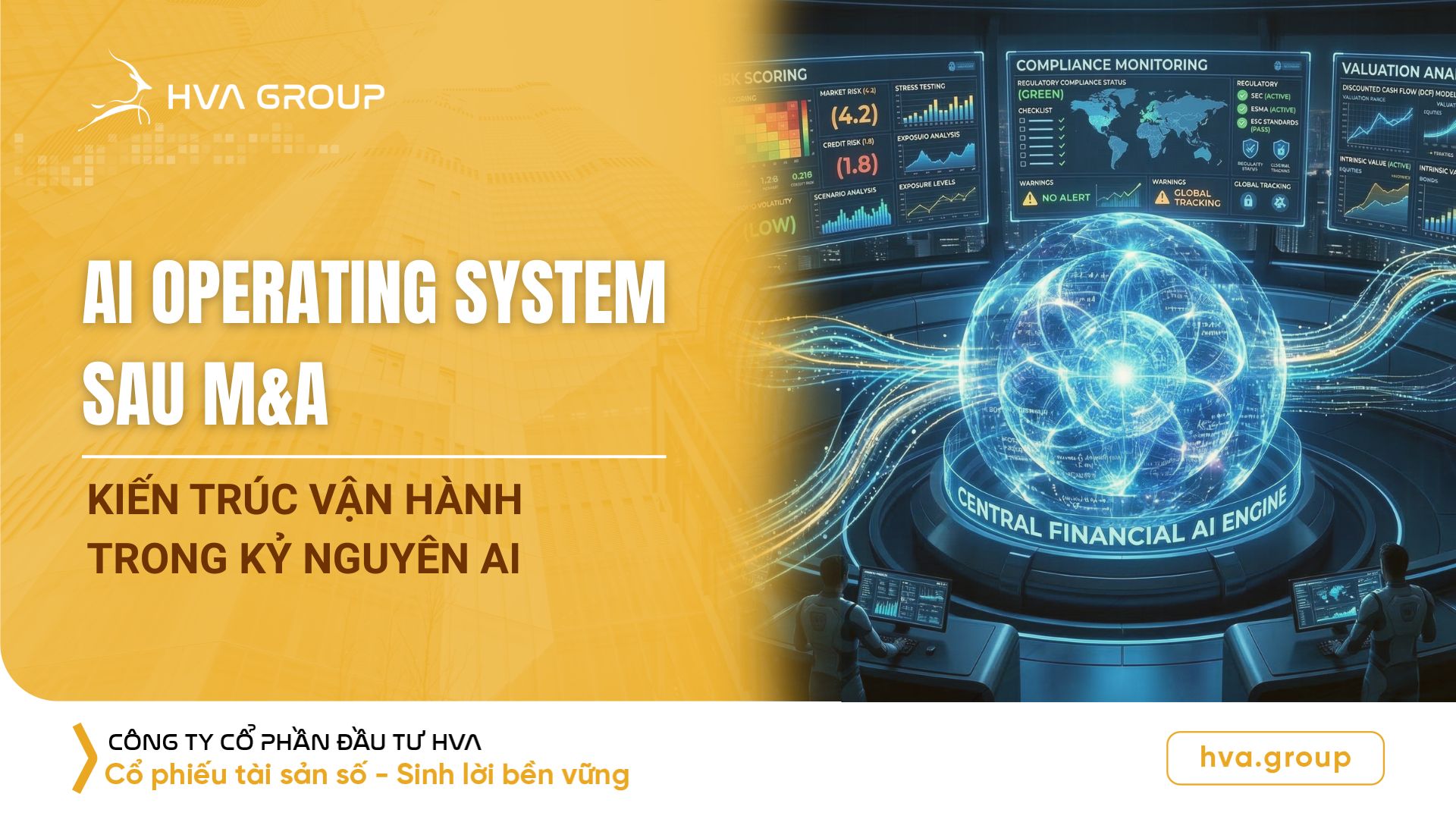
Improve profit margins through AI Operating Systems.
The true value of the “Buy & Transform” strategy lies not in the acquisition itself, but in the ability to upgrade the operational structure afterward. When an AI Operating System is integrated into a business, many changes can occur simultaneously.
Manual processes are standardized and automated, reducing operating costs. Data is centralized and analyzed in real time, shortening decision-making cycles. Continuous risk and compliance monitoring systems minimize losses and enhance reliability.
These improvements often lead to increased profit margins without a corresponding increase in workforce size. Businesses can increase productivity per unit of cost, thereby improving cash flow and valuation. This is the fundamental difference between "buy to retain" and "buy to convert".
“"Buy & Transform" as a strategy for restructuring core competencies.
The "Buy & Transform" strategy should be viewed as a model for restructuring core capabilities rather than an opportunistic investment. This process typically involves assessing the target company's AI readiness, standardizing data, integrating technology infrastructure, and deploying AI modules such as Financial Engine, Risk & Compliance, or Multi-Agent System.
After transformation, the business is no longer a traditional version with a few technical improvements. It becomes a data-driven entity capable of learning and adapting in real time. In that structure, M&A plays the role of a tool for building the business operating system rather than simply expanding the balance sheet.

HVA's strategic positioning
In its long-term strategy, HVA approaches M&A not only with the goal of increasing assets, but also with the goal of building intelligent operating infrastructure for the entire ecosystem. The selection of target companies based on their AI capabilities and potential for integration into AI Operating Systems reflects a deep-seated investment mindset.
Through this strategy, each transaction not only brings short-term financial benefits but also contributes to strengthening the core capabilities of the HVA ecosystem in the data era. In the new competitive environment, successful businesses are not the biggest, but those with the most intelligent operational structure and sustainable scalability.
Conclude
Building from scratch might be suitable in some contexts, especially when the market is still in its infancy. However, in a rapidly changing and fast-paced environment, a “Buy & Transform” strategy offers distinct advantages in terms of time, cost, and scalability.
When properly implemented, acquiring traditional businesses and AI-driven operations not only improves financial efficiency but also restructures an organization's core competencies. And in the AI era, it is these core competencies that determine long-term market position.